UTC (Coordinated Universal Time) is a shared reference. UTC+02:00 means two hours ahead; UTC−05:00 means five hours behind. Some offsets include minutes, such as UTC+05:45.
An IANA name such as America/Toronto identifies a set of local clock rules. An offset describes the difference from UTC at one instant. Daylight saving can change that offset and its abbreviation; UTC itself does not change for daylight saving.
Abbreviations are not unique: CST can mean Central Standard Time in North America or China Standard Time. Use a location, date and numeric UTC offset together. The header shows the offset for the current instant, which may differ from a date you enter.
The Timezone menu groups all supported timezones by country. Selecting one changes the country and region to its configured defaults, resets the country’s date format and selects Manual mode. Timezone abbreviations and offsets describe the current instant and can change with daylight saving.
A timezone alone cannot identify your province or state. Each menu entry has one stable default region; the country’s main zone uses its default region, common shared zones use a named city’s region, and other shared zones use the first matching configured region. IP detection keeps its own valid region metadata instead of applying these manual defaults.
Date-only arithmetic stays on the same calendar dates. The selected timezone controls the live clock, today and the default target zone in Countdown. You can choose a different zone inside Countdown. Explicit calendar inputs are retained when the timezone changes; use Reset to request today in the new zone.
Choosing America/Winnipeg selects Canada, Manitoba, ISO dates and Winnipeg time. Choosing Europe/Paris then selects France, Île-de-France and EU dates.
Common timezone abbreviations
| Abbreviation | Meaning | UTC offset |
|---|---|---|
| UTC | Coordinated Universal Time | +00:00 |
| GMT | Greenwich Mean Time | +00:00 |
| EST / EDT | Eastern Standard / Daylight Time (North America) | −05:00 / −04:00 |
| CST / CDT | Central Standard / Daylight Time (North America) | −06:00 / −05:00 |
| MST / MDT | Mountain Standard / Daylight Time (North America) | −07:00 / −06:00 |
| PST / PDT | Pacific Standard / Daylight Time (North America) | −08:00 / −07:00 |
| NST / NDT | Newfoundland Standard / Daylight Time | −03:30 / −02:30 |
| CET / CEST | Central European Time / Summer Time | +01:00 / +02:00 |
| BST | British Summer Time | +01:00 |
| MSK | Moscow Time | +03:00 |
World timezone map
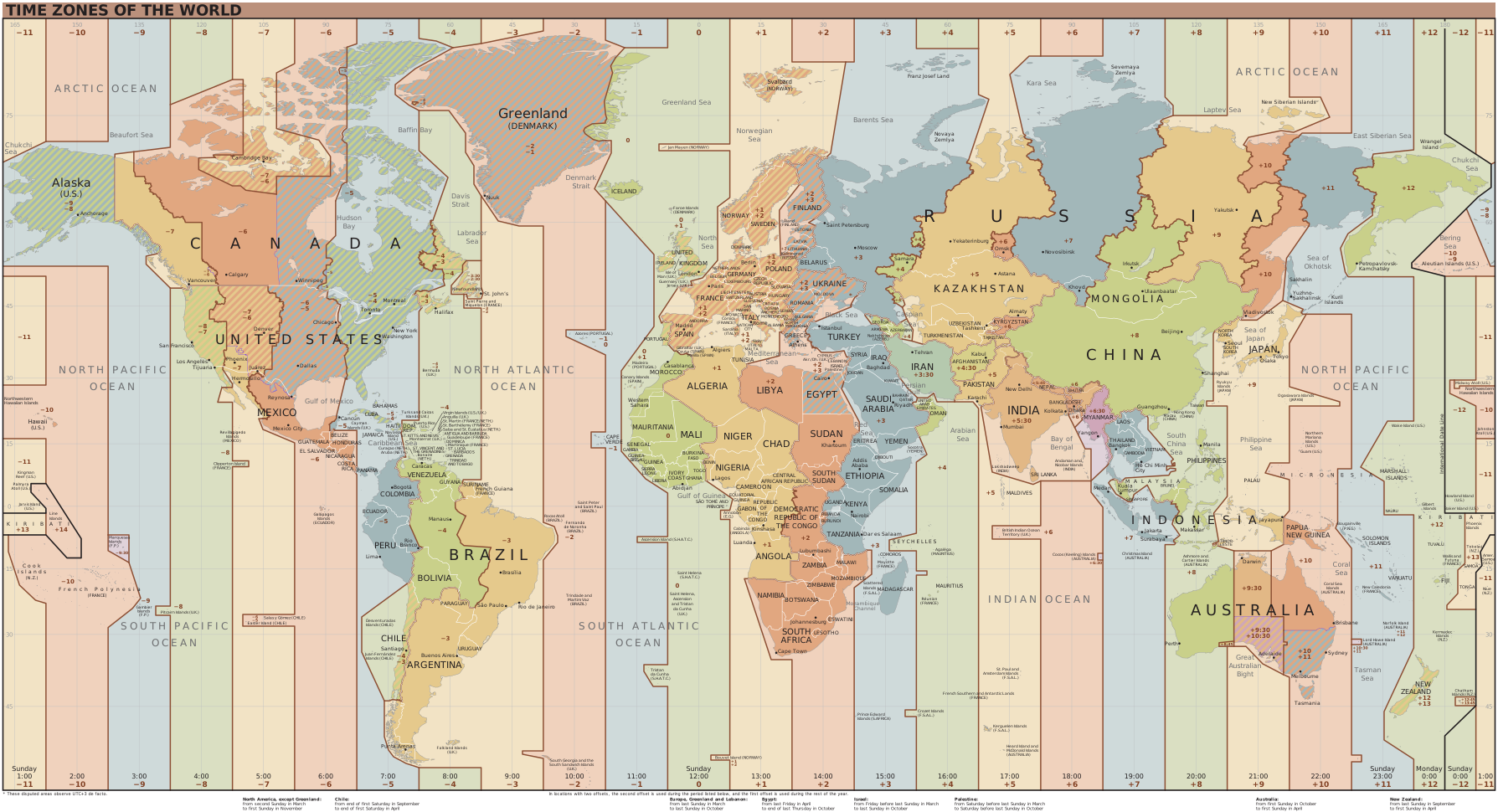
Map labels: English.
This downloaded map is an overview, not a live clock or an official reference. Read its legend for seasonal rules and verify the exact location and date with the responsible authority. Names and boundaries express no political position.
Map by Heitordp, based on a CIA World Factbook outline and IANA timezone information, via Wikimedia Commons. Wikimedia Commons · Public domain — free for commercial reuse.

Only the displayed language was selected; geography and timezone data were not edited.
Last updated: · Local copy downloaded:
Sources and further reading
- IANA — Timezone Database
- IANA — Common timezone abbreviations
- NIST — Timezones, UTC offsets and abbreviations
Worked example
At 12:00 UTC on January 15, 2026, Toronto is 07:00 EST (UTC−05:00) and Paris is 13:00 CET (UTC+01:00). At 12:00 UTC on July 15, Toronto is 08:00 EDT (UTC−04:00) and Paris is 14:00 CEST (UTC+02:00).
Try it →